Market Insights
The Dragonfly Doesn't Chase. It Predicts.
What one of nature's most extraordinary hunters can teach us about seeing what happens next.
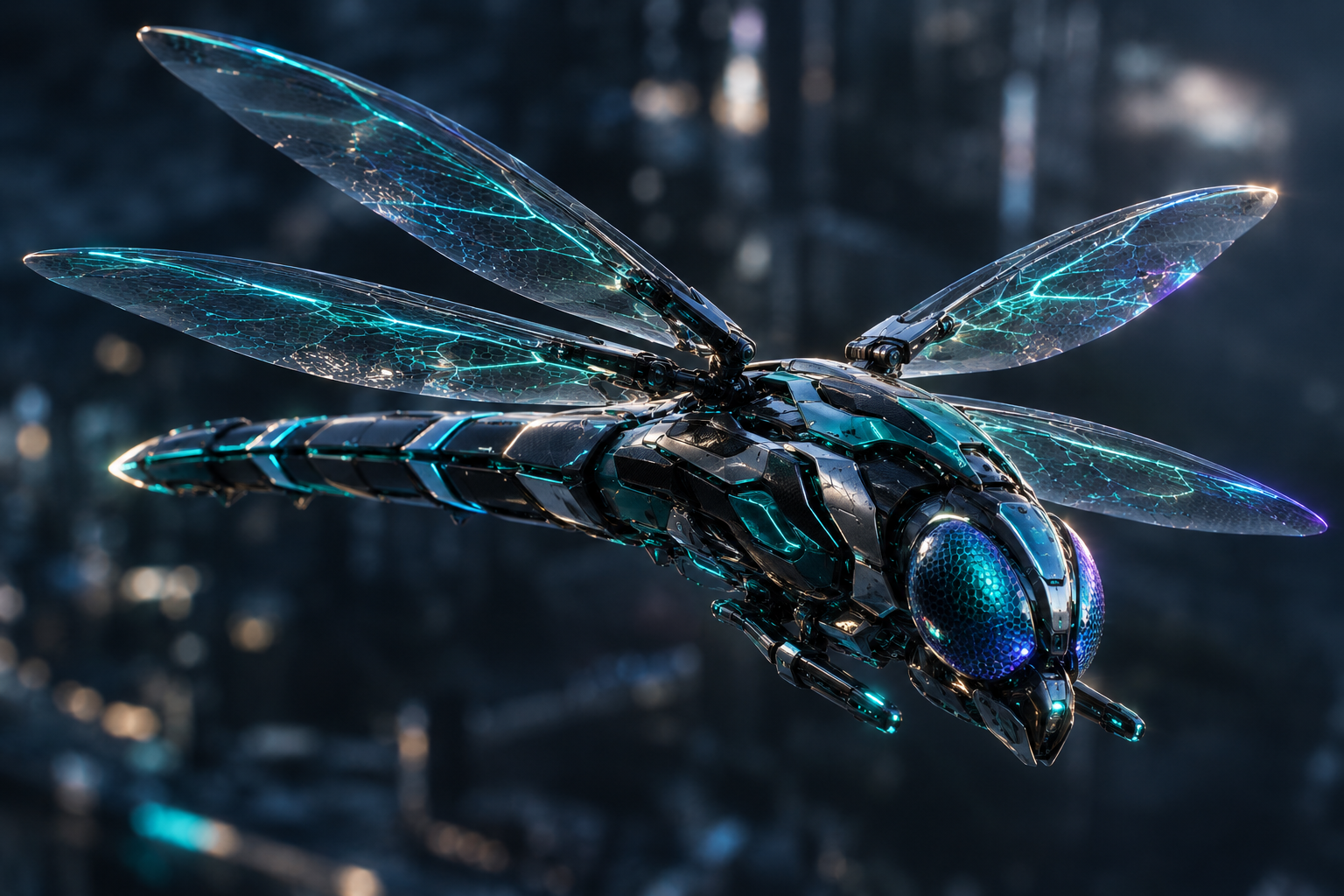
There is something slightly ridiculous about a dragonfly.
It weighs almost nothing. Its brain is tiny. It has been around, in recognisable form, for hundreds of millions of years.
And yet, put one in the air with a moving target and it becomes an astonishingly sophisticated interception system.
Dragonflies have enormous compound eyes containing up to 30,000 individual lenses per eye. Their brains can process visual information at roughly 200 images per second. They can pick a tiny moving target out of visual clutter, lock their attention onto it and — most interestingly — calculate where it's going.
Then they fly there.
Not where the target is.
Where it's going to be. [2]
That idea became one of the inspirations behind Hirelytiq.
Not because recruitment agencies need to behave like predatory insects.
Although, depending on the agency, the analogy may occasionally hold up.
But because the dragonfly does something remarkably similar to what good business development is trying to do:
See the wider environment. Detect something important. Work out where it's heading. Get there early.
And the deeper you go into how dragonflies actually do this, the stranger — and more impressive — they become.
First: those eyes are absurd
Look closely at a dragonfly and you'll quickly notice that its head is basically eyes with an insect attached.
Its two enormous compound eyes can contain as many as 30,000 ommatidia each — individual visual units, each with its own tiny lens and pointing in a slightly different direction.
The result is an enormous field of vision approaching 360 degrees. [1]
Those eyes are absurd
3 images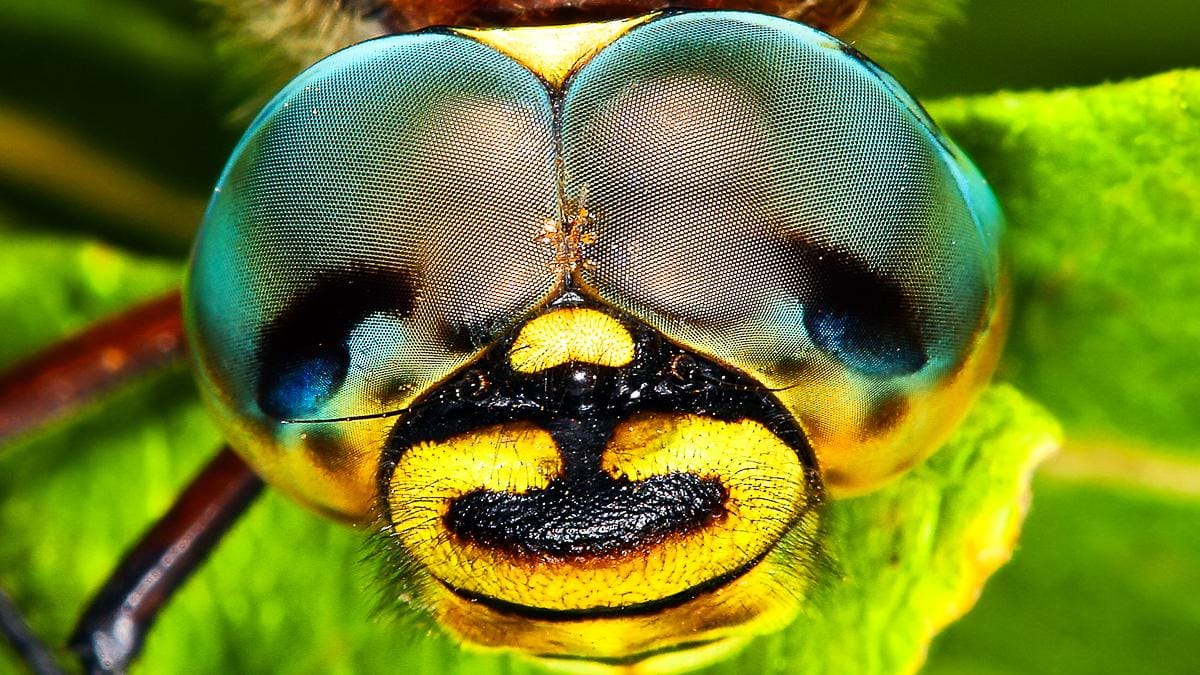
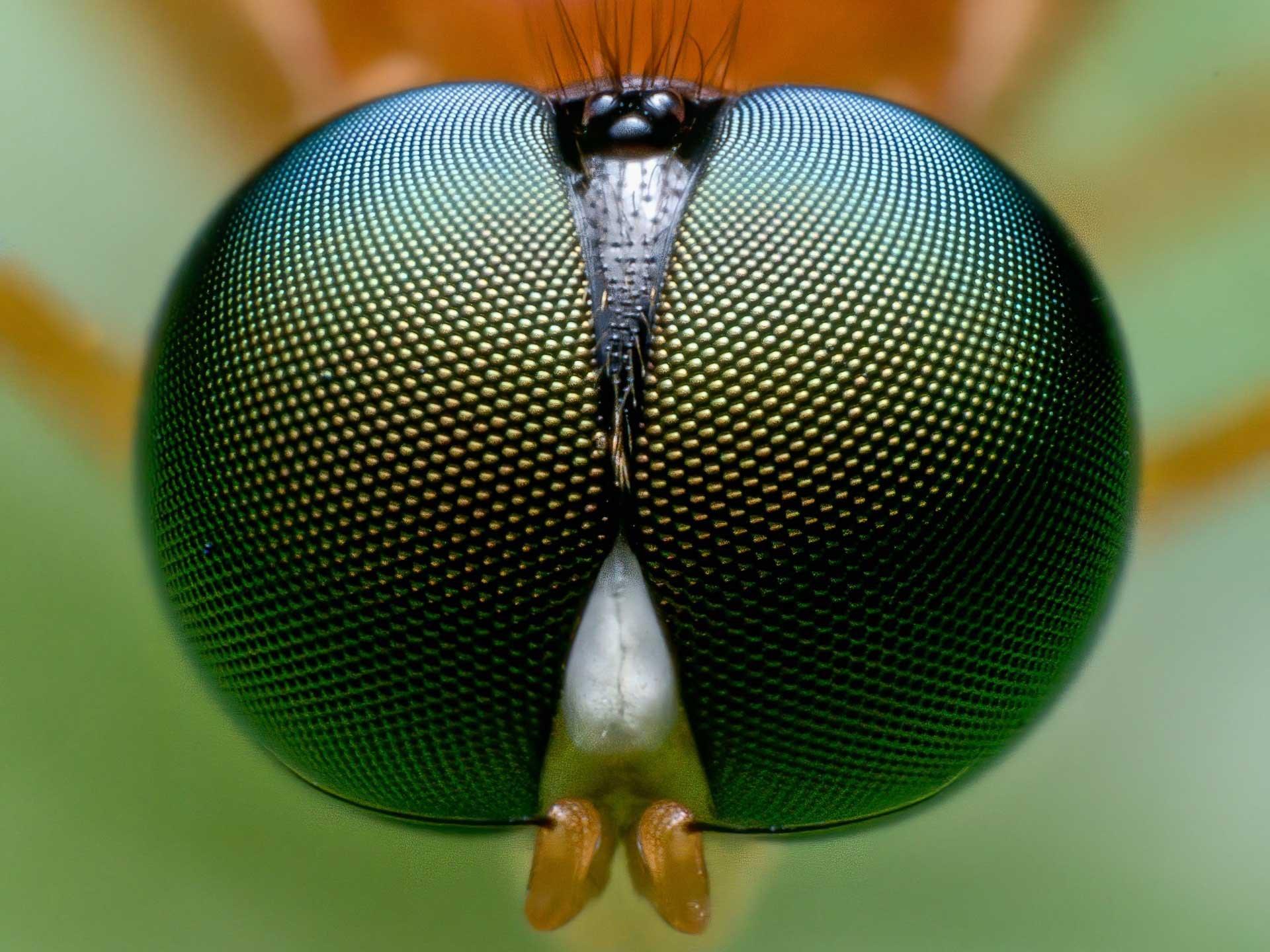
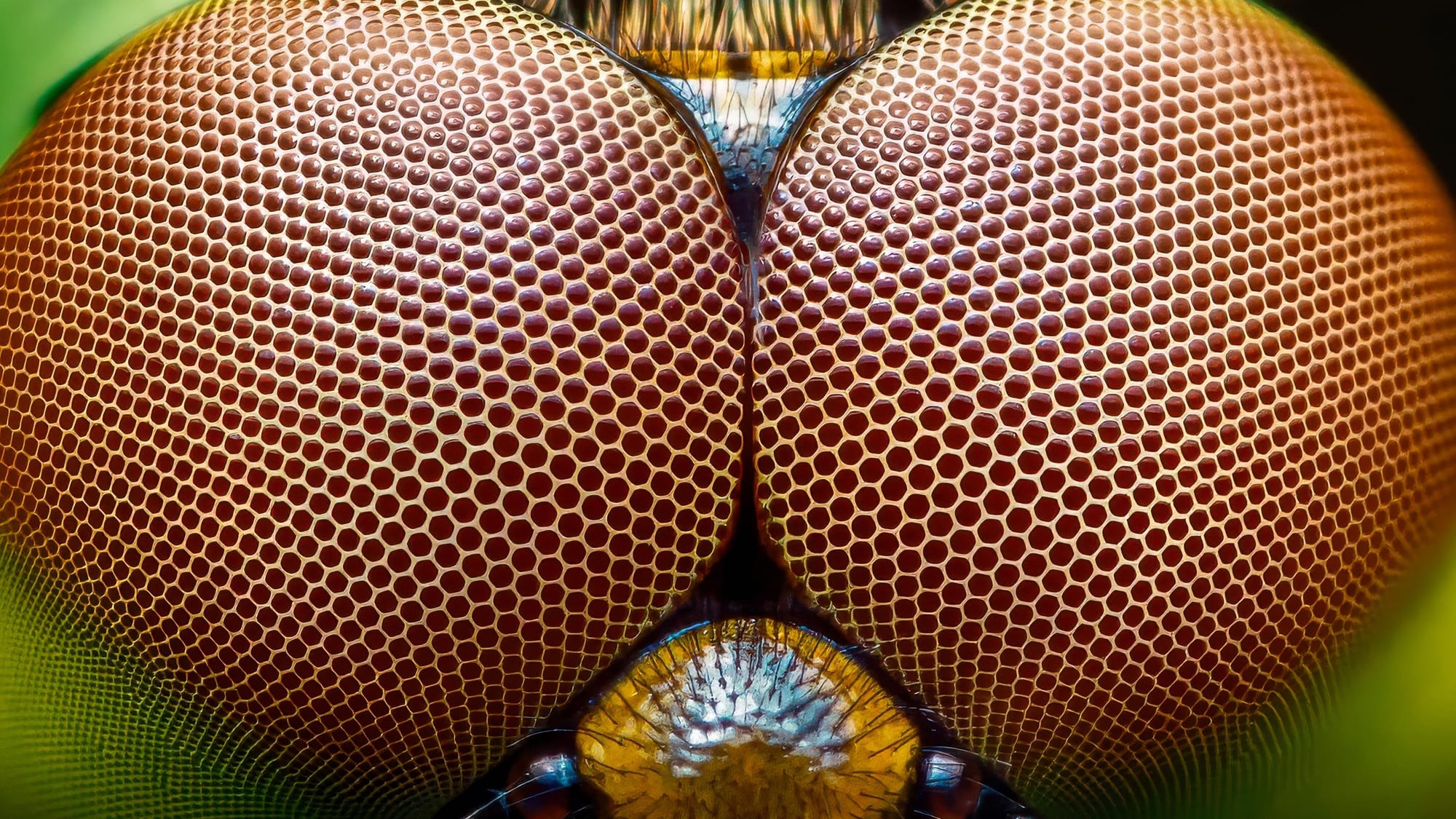 Compound-eye details. Scroll to explore; select an image to view full size.
And those aren't its only eyes.
A dragonfly also has three simple eyes called ocelli, which are thought to play a role in functions such as flight stabilisation. So in one sense, a dragonfly really does have five eyes — just not five eyes doing the same job. [1]
Humans, meanwhile, have two eyes with one lens each.
It's probably best not to take that personally.
But the interesting part isn't simply that the dragonfly can see a lot.
It's what it does with all that information.
Because seeing everything is useless if you can't identify what matters.
Seeing more isn't the same as knowing what to look at
Imagine trying to follow one specific fly through a swarm.
The target is tiny.
The background is moving.
The dragonfly itself is moving.
Other insects are moving.
Everything is changing simultaneously.
Yet researchers have identified specialised neurons in dragonflies known as Small Target Motion Detectors, or STMDs, which respond to tiny moving targets even against complex natural backgrounds. [4]
It gets better.
Research into a particular neuron called CSTMD1 found behaviour resembling selective attention.
When researchers presented competing targets, the neuron didn't simply blend all the information together.
It could effectively select one.
A kind of biological:
That one.
Research has described this as a "winner-takes-all" response — processing one target while effectively ignoring the competing alternative. [5]
That's an important distinction.
The dragonfly's advantage isn't:
MORE DATA.
It's:
Find the useful signal inside the data.
That distinction is one we think about a lot at Hirelytiq.
There are thousands of things happening across a recruitment market every day.
Companies raise money.
Win contracts.
Lose contracts.
Hire executives.
Open offices.
Enter new markets.
Launch products.
Make acquisitions.
Change strategy.
Most of it is noise to any individual recruiter.
Occasionally, however, one of those events is the beginning of something else.
A future hiring requirement.
The interesting question isn't simply:
What happened?
It's:
Which event should I pay attention to?
But this is where things get really interesting.
Watch what happens when a dragonfly locks onto a moving target.
Download or open the video The dragonfly doesn't simply chase the target's current position. Its steering incorporates predictions about the prey's movement.Supplied interception explainer; illustrative animation. Original vertical framing preserved.
Spotting the target is only step one.
A dragonfly hunting another flying insect has a fairly serious mathematical problem to solve.
If it simply aims for where its prey currently is, then by the time it gets there, the prey has moved.
So it doesn't.
Research published in Nature tracked dragonflies' head and body movements during interception and found evidence that their steering uses internal models of both their own movement and the movement of their prey. [2]
In simpler terms:
The dragonfly predicts.
Its head keeps track of the target while its body manoeuvres onto an interception course.
Researchers found that much of this steering couldn't be explained as simple reactive chasing. The dragonfly appeared to be using predictive control, while vision helped it respond when the prey did something unexpected. [2]
That is extraordinary for an animal with such a small nervous system.
And it produces a completely different hunting strategy.
A chase looks like this:
TARGET MOVES → FOLLOW TARGET → TARGET MOVES → FOLLOW AGAIN
An interception looks more like:
OBSERVE → ESTIMATE TRAJECTORY → MOVE TOWARD FUTURE POSITION
The difference is tiny on paper.
In practice, it's everything.
Don't chase where the opportunity is.
Work out where it's going.
This was the part of dragonfly behaviour that really resonated with how we think about recruitment.
Most recruitment intelligence describes the present or the past.
A company has posted a vacancy.
A hiring manager has advertised a role.
A competitor has started recruiting.
Useful information.
But something has already happened.
The hiring need existed before the vacancy appeared.
The budget was approved before the advert.
The expansion happened before the new team was built.
The contract was won before delivery capacity needed to increase.
The funding arrived before headcount expanded.
There is a period between the cause and the visible hiring outcome.
We call that the pre-hire window.
And that's the part we're interested in.
Not because every funding round means a company will hire.
It doesn't.
Not because every executive appointment predicts a vacancy.
It doesn't.
But because events create trajectories.
And trajectories can be studied.
That's where the dragonfly analogy stops being just a nice piece of branding and becomes a genuinely useful way of thinking about the problem.
And apparently they're frighteningly good at it
Dragonflies aren't merely competent aerial hunters.
Studies of dragonfly predation have reported successful pursuits above 95% under studied conditions. [1]
Think about what the animal is doing during one of those pursuits.
It has to:
detect a tiny target
→ distinguish it from the background
→ select it amongst competing targets
→ track its movement
→ account for its own movement
→ estimate where the target is heading
→ steer an interception course
→ correct when reality deviates from the prediction
→ catch it in mid-air.
All in seconds.
There is a nice lesson buried in that.
Prediction doesn't mean knowing the future with certainty.
It means continuously forming the best model of what is likely to happen next — and adjusting when new information arrives.
That's much closer to how useful prediction actually works.
Want to see just how ridiculous this hunting system is?
This explanation was one of the clips that sent us down the dragonfly rabbit hole.
Download or open the video Watch original on TikTok ↗60,000 lenses. One target.
The numbers around dragonfly vision sound almost made up.
Up to 30,000 lenses in each compound eye.
Near-panoramic vision.
Three additional ocelli.
A brain capable of processing around 200 images per second.
Some species possess as many as 30 different opsin proteins associated with detecting colour and light, compared with three types of colour-sensitive cone opsins in humans. [1]
Yet all of that sensory capability ultimately serves a very simple purpose:
Make a better decision about where to move.
That is why the visual language around Hirelytiq increasingly uses facets, fields, trajectories and intercept points.
The facets represent perception.
The trajectory represents prediction.
The intercept represents opportunity.
The interesting bit isn't having more information.
It's seeing something in it before everyone else does.
Then there are the wings.
Dragonflies are exceptional flyers.
And this is another part of the animal that interested us.
Instead of one pair of wings, they have four.
That architecture gives them remarkable control in the air: hovering, rapid acceleration, sharp directional changes and highly controlled pursuit.
But the interesting parallel for us comes after the prediction.
Knowing something might happen isn't particularly useful if you can't do anything with it.
Eventually intelligence has to become action.
For a recruiter, that means understanding the company, finding the relevant person, establishing why the conversation is worth having and actually making contact.
So our own visual system starts with thousands of facets and eventually opens into movement.
See.
Predict.
Understand.
Connect.
The wings aren't really about speed.
They're about having enough control to turn perception into movement.
They've had a little time to practise.
Around 300 million years ago, long before Tyrannosaurus rex, the skies already contained enormous dragonfly-like insects.
They weren't technically modern dragonflies. They were griffinflies — relatives with a remarkably similar body plan.
Some had wingspans approaching 71 centimetres.
That's roughly the width of a small hawk.
Flying around.
Except it's an insect.
Which is not a sentence anyone particularly needs to experience in real life. [1]
Before modern dragonflies
4 images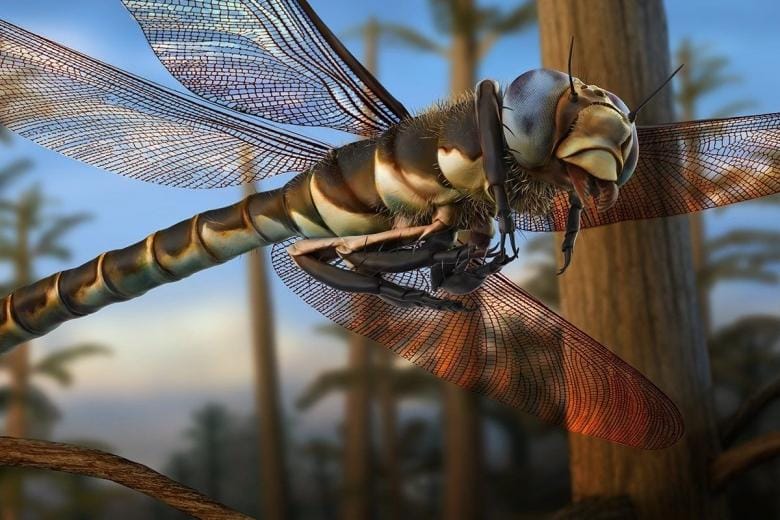

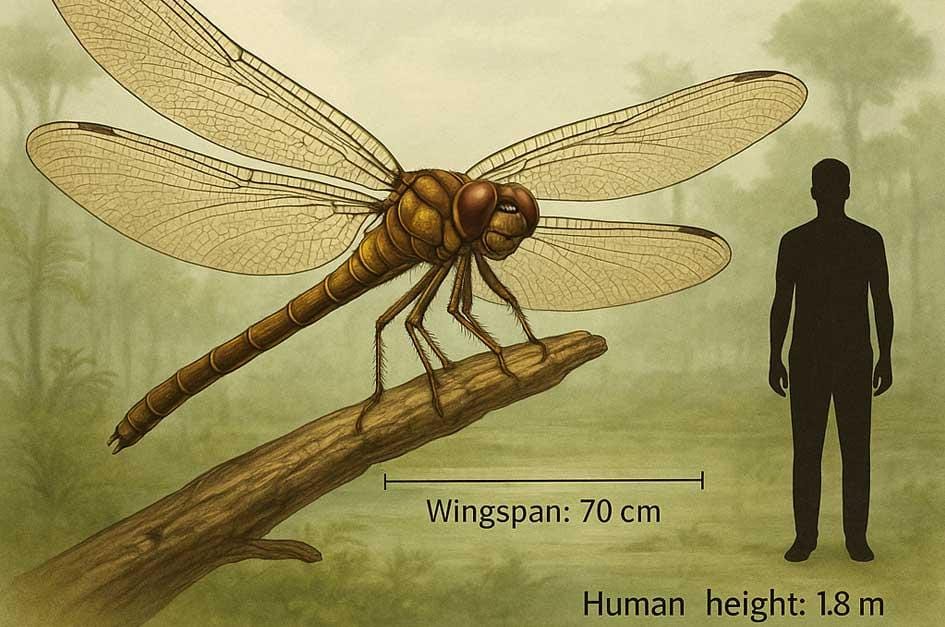
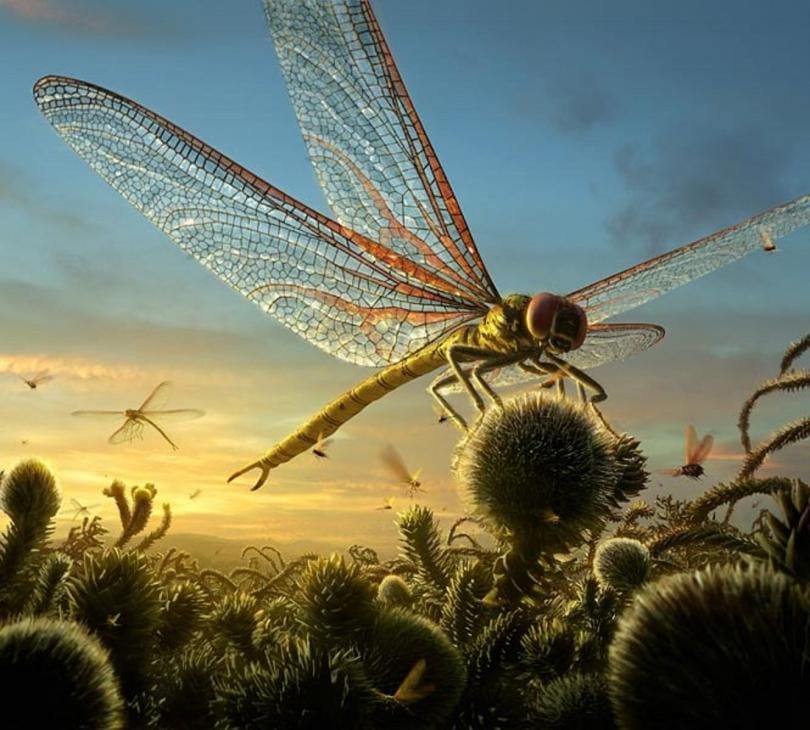 User-supplied artistic reconstructions of prehistoric griffinflies: relatives of modern Odonata, not modern dragonflies. These are illustrations, not fossil photographs or measured scale drawings. Scroll to explore; select an image to view full size.
The broader lineage is ancient enough that dragonfly-like aerial predators were flying hundreds of millions of years before humans existed.
Their size changed.
Their environment changed.
Competitors changed.
Predators appeared.
Yet the basic concept proved remarkably durable:
See exceptionally well. Fly exceptionally well. Catch moving things.
Three hundred million years is a fairly convincing product-development cycle.
And some of them apparently decided continents weren't enough.
Meet Pantala flavescens.
The globe skimmer.
It is only around a few centimetres long, yet evidence suggests populations participate in an extraordinary multi-generational migration circuit between Asia and Africa spanning roughly 14,000–18,000 kilometres. [6]
Part of that journey crosses the Indian Ocean.
Not around it.
Across it.
Research suggests individual globe skimmers on parts of this route may travel more than 6,000 km, including an ocean crossing of roughly 3,500 km. [6]
They exploit large-scale atmospheric systems and seasonal winds, while the wider migration follows rainfall that creates the temporary freshwater habitats needed for breeding. [6]
Flight across continents
5 images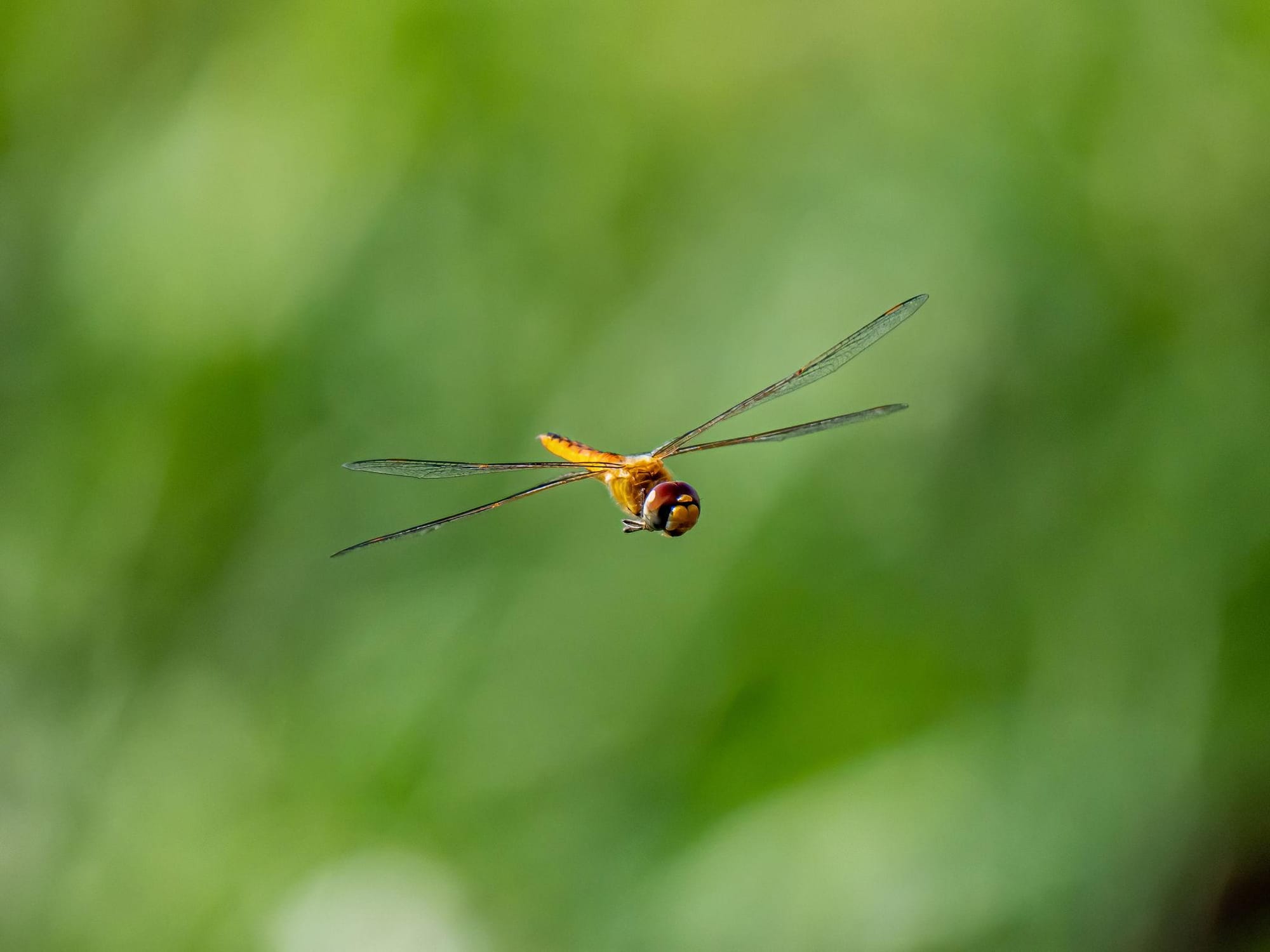
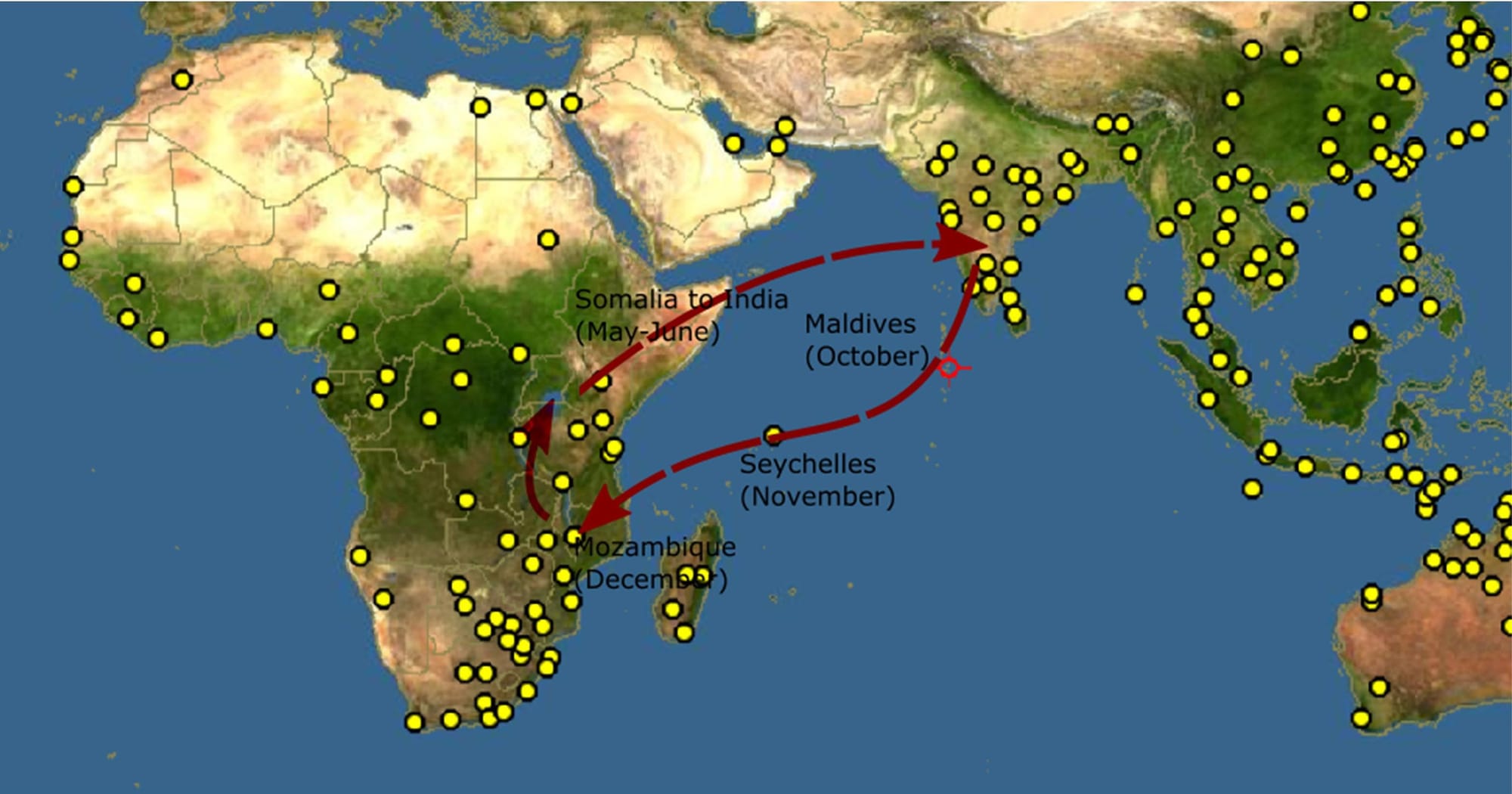
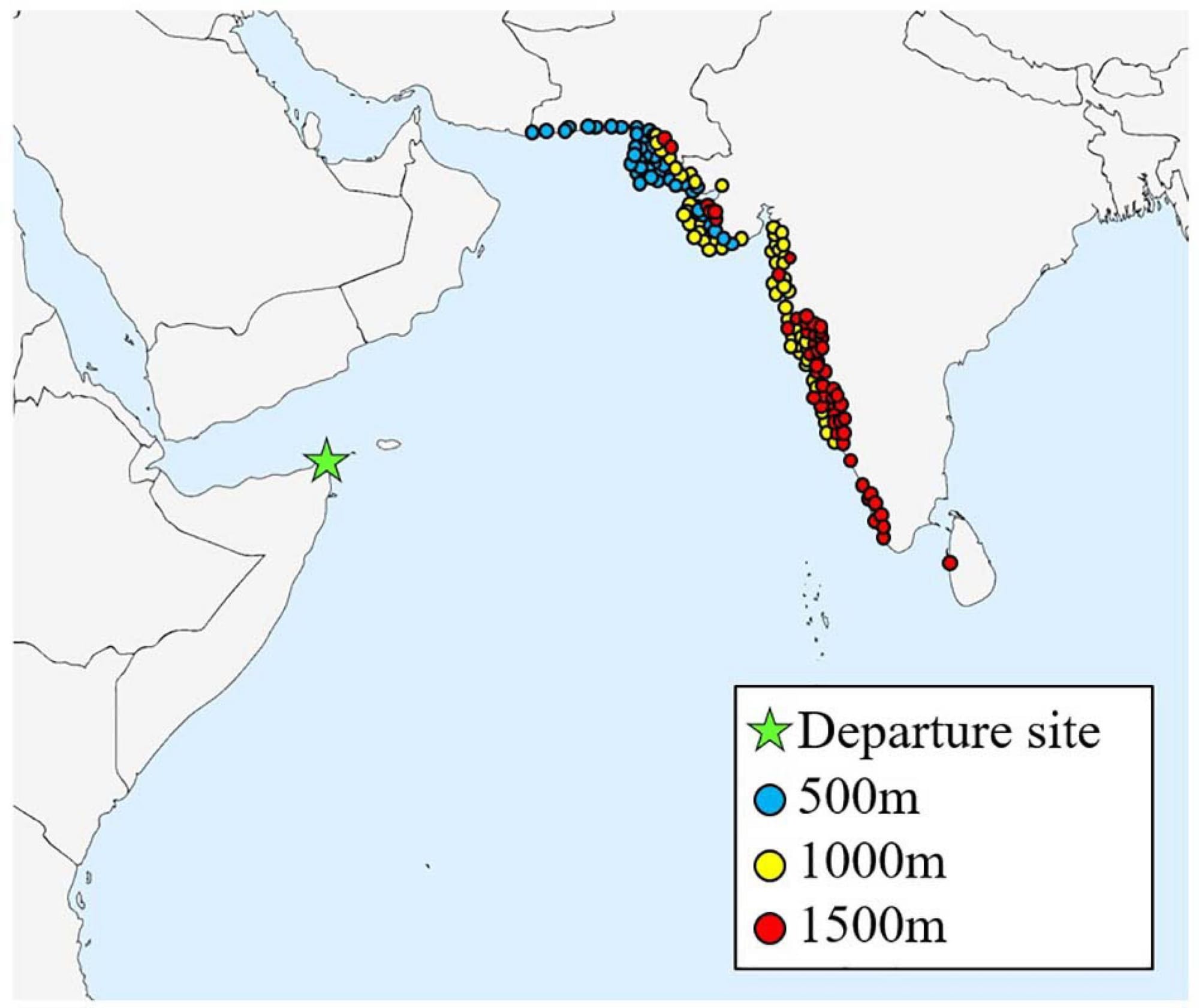
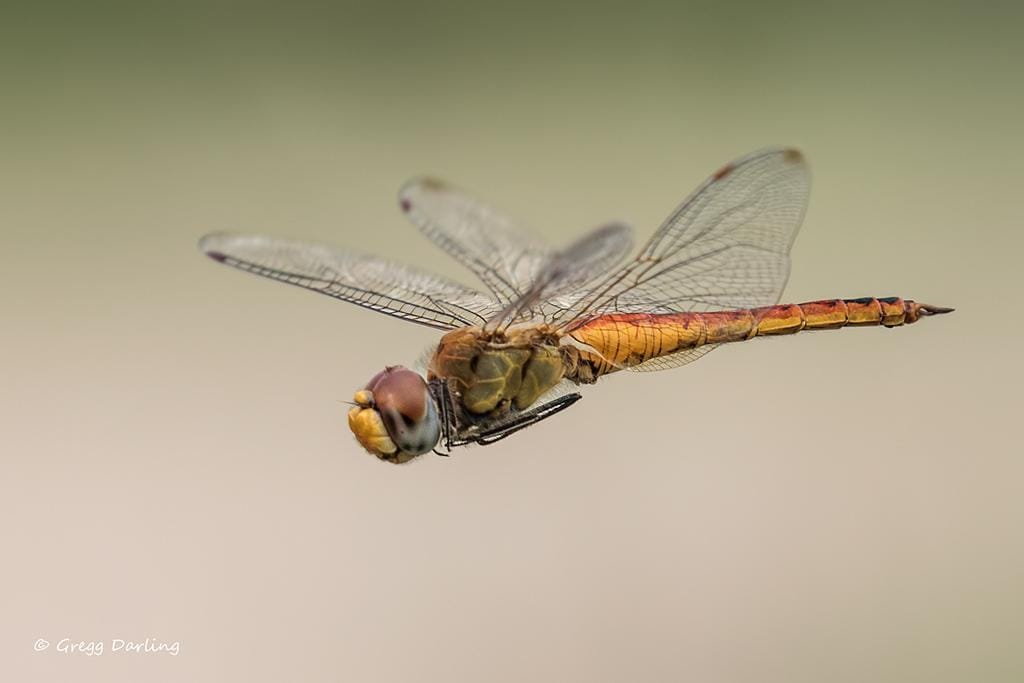
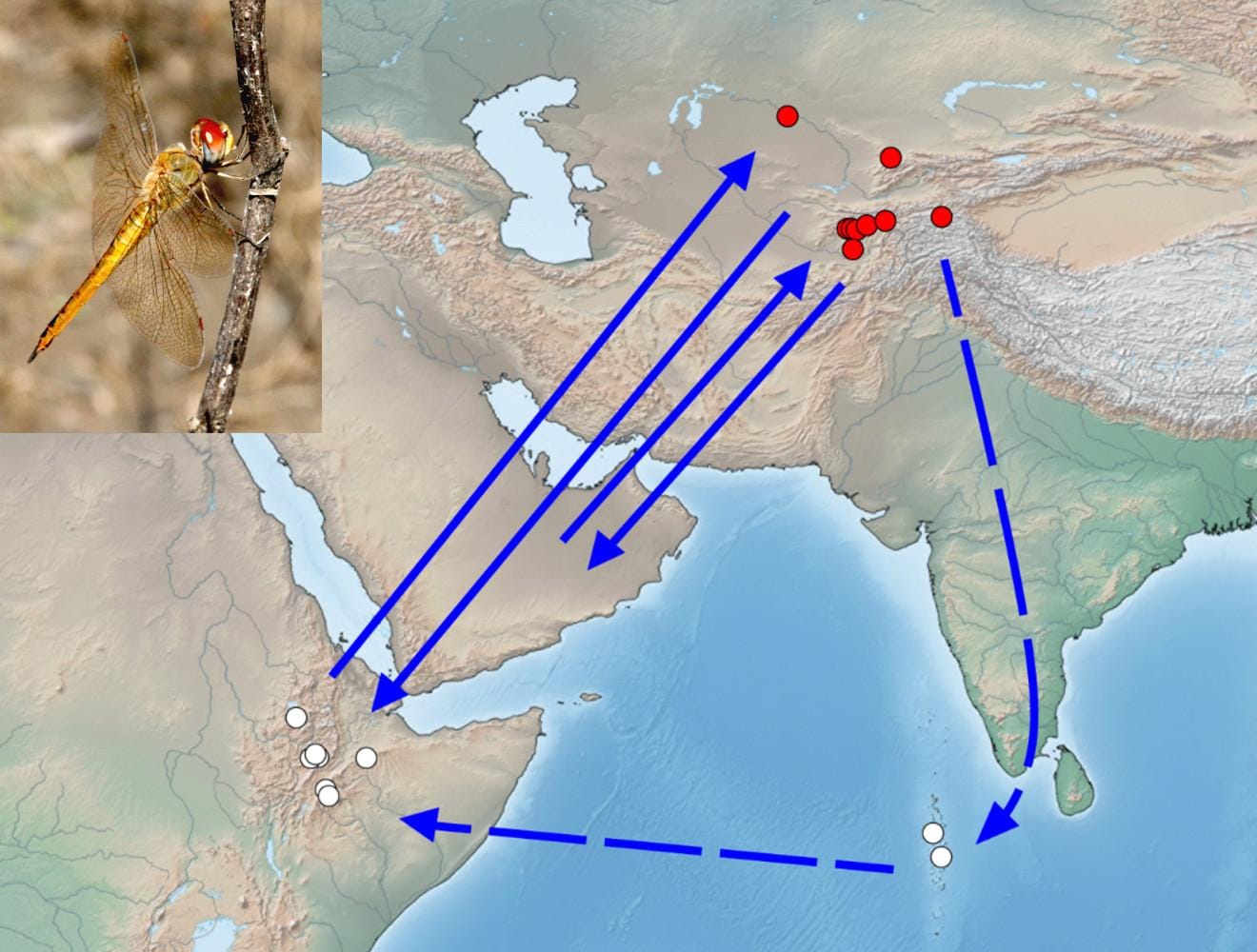 Flight photographs and migration maps. The 14,000–18,000 km circuit spans multiple generations, not one insect's journey. Flight photograph watermark: © Gregg Darling. Scroll to explore; select an image to view full size.
There is something particularly interesting about that.
The destination isn't valuable because it's valuable now.
The journey is tied to conditions changing across enormous distances — winds, rains, temporary pools and breeding opportunities.
In other words:
Move at the right time and opportunity exists when you arrive.
Move too late and the conditions have changed.
That's probably stretching the recruitment metaphor far enough.
But it is objectively a very cool insect.
Most of its life isn't spent flying
There's one final detail we like.
The dragonfly we notice — the iridescent animal darting across a pond — is only one stage of its life.
Before adulthood, dragonflies live underwater as aquatic nymphs.
Depending on species and environmental conditions, that immature stage can last months or even years.
Down there, they are already predators.
They grow.
Moult repeatedly.
Hunt.
Develop.
And eventually climb out of the water, undergo their final transformation and take to the air.
So the spectacular part is only the bit we see.
Most of the preparation happened beforehand.
There is probably a recruitment analogy hiding in there too.
We'll leave that one to you.
So, why the dragonfly?
Initially, we were looking for a visual language for prediction.
Not crystal balls.
Not AI brains.
Not another glowing robot.
Something based around perception, trajectory and timing.
The more we looked into the dragonfly, the more interesting the comparison became.
It sees an enormous field.
It can isolate a tiny target amongst visual clutter.
Its neural systems favour continuous trajectories.
It uses predictive models during interception.
It constantly corrects those predictions when the target behaves unexpectedly.
And then it moves.
So we borrowed the principles rather than the insect itself.
That's why much of Hirelytiq's visual language doesn't contain a dragonfly at all.
You'll see facets.
You'll see signals.
You'll see paths.
You'll see a point somewhere ahead where two trajectories meet.
Because the most interesting thing about a dragonfly isn't what it looks like.
It's how it thinks.
See the market. Predict the opportunity. Arrive early.
There's a tendency in business to treat prediction as something futuristic.
It isn't.
Nature has been doing it for hundreds of millions of years.
The dragonfly's version just happens to involve 60,000 tiny lenses, specialised target-detecting neurons, four wings and the occasional mid-air assassination.
Ours involves recruitment data.
We know which one we'd rather explain in a product demo.
Sources & further reading
- Natural History Museum — Dragonflies: The ultimate hunters
Compound eyes, near-panoramic vision, visual processing, ocelli, colour sensitivity and hunting success.
- Mischiati et al., Nature (2015) — Internal models direct dragonfly interception steering
Predictive interception, internal models and correction when prey movement changes. DOI: 10.1038/nature14045.
- Combes, Nature — Dragonflies predict and plan their hunts
Commentary on the predictive-interception research.
- A predictive focus of gain modulation encodes target trajectories in insect vision
Small-target motion detection and predictive facilitation along target trajectories.
- A Target-Detecting Visual Neuron in the Dragonfly Locks on to Selectively Attended Targets
Selective attention, target locking and filtering competing targets.
- Hobson et al. — Globe Skimmer migration research
Evidence for an Afro-Asian multi-generational migration circuit and trans-oceanic crossings.
- Global population genetic study of Pantala flavescens
Further evidence and discussion of the globe skimmer’s migratory range.